

Commercial door locks are one of the most critical components of any building security system. Whether installed in offices, hotels, hospitals, schools, apartment complexes, or government facilities, the right lock protects people, property, and business operations — while keeping the building compliant with fire safety and building codes.
At D&D Hardware, we have spent over 18 years manufacturing certified commercial door locks for metal doors, wooden doors, and fire-rated doors, supplying projects across Europe, North America, the Middle East, and Asia. Our CE and UL certified mortise locks are used in hospitals, hotels, schools, and government buildings worldwide.
This guide explains what building owners, contractors, architects, distributors, and project managers need to consider when specifying a commercial door lock, with practical guidance on lock types, certifications, fire ratings, and how to match the right product to each application.
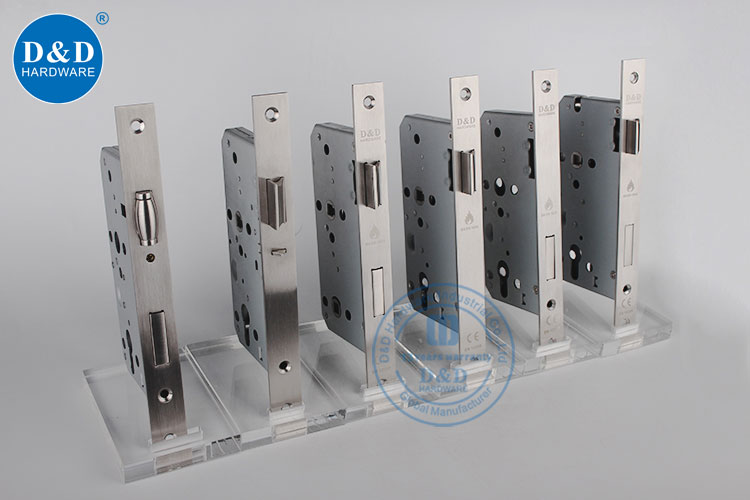
Why Commercial Door Locks Are Different from Residential Locks
Commercial door locks are engineered for an entirely different scale of use.
In a busy office or hospital corridor, a single door may be opened and closed thousands of times every month. A lock that performs adequately in a home will often fail prematurely in that environment. Beyond durability, commercial projects must also meet stricter building codes, fire safety regulations, and security requirements.
Key differences include:
- Cycle-tested durability — commercial locks are independently tested for hundreds of thousands to over one million operating cycles
- Fire door compliance — locks on fire-rated doors must be certified as part of the fire door assembly
- International certification — commercial projects typically require CE, UL, ANSI/BHMA, or equivalent certified hardware
- Security performance — anti-prying, anti-card, and forced-entry resistance standards apply
- Project-scale consistency — finishes, dimensions, and functions must coordinate across the entire hardware schedule
Choosing the wrong lock — even one that appears similar — can result in compliance failures, premature replacement costs, and in the worst case, a compromised fire door assembly.
Step 1: Identify the Building Type and Required Security Level
Security requirements vary significantly between building types. A hospital corridor door, a school classroom, a hotel guest room, and a warehouse storage room each have different functional needs, usage frequencies, and compliance obligations.
| Building Type | Typical Security Requirement | Recommended Lock Type |
| Office Buildings | Medium to High | Mortise — Entry, Office, or Storeroom function |
| Hotels | High | Mortise — Entry, Privacy, or Apartment function |
| Hospitals & Healthcare | Medium to High | Mortise — fire-rated, with smooth operation |
| Schools & Universities | High | Mortise — Classroom or Storeroom function |
| Government Buildings | High | Mortise — certified, with master key system |
| Industrial / Warehouses | High | Mortise — Storeroom or Deadlock function |
| Apartment Buildings | Medium | Mortise — Apartment or Privacy function |
| Public Toilets | Low to Medium | Mortise — Bathroom or Public Toilet function |
Before specifying a lock, evaluate the daily traffic volume, emergency exit requirements, occupancy type, and whether the door forms part of a fire-rated assembly.
Step 2: Choose the Right Lock Type
Mortise Locks — The Commercial Standard
For most commercial applications, a mortise lock is the correct choice.
The lock body is installed inside a pocket cut into the door edge, creating a robust and structurally integrated locking mechanism. Because the lock case is fully recessed, it distributes mechanical load inside the door rather than on the surface — giving significantly higher resistance to forced entry, prying, and impact compared with surface-mounted or cylindrical alternatives.
Mortise locks are compatible with timber, steel, and fire-rated doors, and can be specified in CE or UL versions depending on the target market.
D&D CE Mortise Locks are tested to:
- BS EN 12209 — 200,000 operating cycles
- EN 1634 — fire resistance up to 111 or 260 minutes
- EN 1670 — 240 hours corrosion resistance
D&D UL Mortise Locks are tested to:
- ANSI/BHMA A156.13 Grade 1 — 1,000,000 operating cycles
- UL 10C — 3-hour fire rating
- UL Listed — File No. R40901
Both product lines are manufactured in stainless steel SUS304 for strength and corrosion resistance.
Cylindrical / Tubular Locksets
Cylindrical locksets are faster to install and lower in cost than mortise locks. They are suitable for medium-traffic interior doors where fire certification is not required.
D&D supplies ANSI/BHMA tubular lever locksets and cylindrical knob locks for office interiors, residential buildings, and retail applications. However, for fire-rated openings, stairwells, corridor doors, and any high-traffic or high-security application, a certified mortise lock is the recommended specification.
Deadbolt Locks
Deadbolts provide an additional locking layer using a solid bolt that extends into the door frame. They are commonly used on storage rooms, utility spaces, and secondary entrances where keyless re-entry is required.
D&D's DDML013 Mortise Deadbolt Lock (CE EN12209) and Deadlock Lock Body (DDML029-B) are designed for these applications.
Specialised Lock Types
D&D also manufactures locks for specific applications:
- Sliding Door Hook Lock (DDML031) — prevents door lifting and forced sliding on commercial sliding door systems
- Narrow Stile Lock (DDML021) — compact mortise case for slim aluminium door profiles and glass door systems
- Mortise X-Ray Lock (DDML027) — designed to prevent X-ray penetration, used in hospital imaging rooms and radiology departments
- Magnetic Mortise Lock (DDML044) — magnetic latch bolt for smooth, quiet operation on high-frequency commercial doors
- Emergency Escape Lock (DDML009-E) — single-action release of both latchbolt and deadbolt from inside; required for fire escape doors
Step 3: Match the Lock Function to the Door Application
This is the most commonly overlooked step in commercial lock specification — and one of the most important.
A mortise lock body can be configured in many different functions. Specifying the wrong function means the door will not operate correctly for its intended use, even if the hardware is otherwise high quality.
The following table shows D&D's standard mortise lock functions and their typical applications:
CE Euro Mortise Lock Functions
| Function | Model | How It Works | Typical Application |
| Sash Lock | DDML009 | Latch by lever both sides; deadbolt by key/thumbturn | Main entry, office, corridor |
| Emergency Escape | DDML009-E | Single-action inside release for both bolts | Fire escape doors, stairwells |
| Roller Latch | DDML010 | Roller bolt closes automatically from either side | High-frequency interior doors |
| Latch Lock | DDML011 | Latch by lever both sides, no locking | Internal passage doors |
| Bathroom Lock | DDML012 | Latch by lever; deadbolt by inside thumbturn | Hotel bathrooms, WC |
| Deadbolt Lock | DDML013 | Deadbolt only, by key or thumbturn | Storage, back-of-house |
| Night Latch | DDML014 | Auto-relocks on door close; key from outside | Exit doors, back entrances |
| Classroom Lock | DDML015 | Inside lever always free; outside locked by key | Schools, training rooms |
| Narrow Stile | DDML021 | Compact case for slim aluminium profiles | Aluminium and glass doors |
| X-Ray Lock | DDML027 | X-ray shielded lock case | Hospital imaging rooms |
| Deadlock Body | DDML029-B | Deadbolt only, controlled access | Controlled entry points |
| Sliding Door Hook | DDML031 | Hook bolt prevents door lifting | Sliding commercial doors |
| Magnetic Latch | DDML044 | Magnetic latch bolt, quiet operation | High-traffic, quiet environments |
UL ANSI Mortise Lock Functions
| Function | Model | How It Works | Typical Application |
| Passage | DDAL01 | Latch by lever both sides, always free | Corridors, closets |
| Entry | DDAL04 | Outside lever lockable; key or inside lever to retract | Office entry, hotel room |
| Classroom | DDAL05 | Inside always free; outside locked by key | Schools, universities |
| Storeroom | DDAL07 | Outside lever always inactive; key required | IT rooms, storage, pharmacies |
| Public Toilet | DDAL09 | Inside thumbturn locks outside lever | Public WC, amenity rooms |
| Exit / Dormitory | DDAL13 | Inside lever retracts both bolts and unlocks outside | Dormitories, exit doors |
| Deadlock | DDAL18 | Deadbolt by key from outside only | High-security controlled areas |
| Privacy | DDAL19 | Inside thumbturn; emergency release outside | Hotel rooms, private offices |
| Apartment | DDAL20 | Full deadbolt and latch control; key from both sides | Apartment corridor doors |
| Bedroom | DDAL22 | Inside thumbturn locks outside; emergency release | Residential, hotel rooms |
Step 4: Verify Fire Door Compliance
Many commercial buildings contain fire-rated doors designed to compartmentalise fire and smoke during emergencies. When a lock is installed on a fire-rated door, the lock must itself be certified as part of that fire door assembly. Using a non-certified lock on a fire door can compromise the entire assembly and result in inspection failure.
Fire-rated door openings commonly include stairwell doors, corridor doors, hotel room entrances, hospital room doors, and all doors forming part of a protected means of escape.
For CE projects, D&D's EN 1634-certified mortise locks are fire tested to 111 minutes (FD60) and 260 minutes (FD120+), suitable for fire door assemblies across European markets.
For UL projects, D&D's UL 10C-certified mortise locks carry a 3-hour fire rating (UL Listed, File No. R40901), meeting North American fire door requirements.
Always confirm the certification standard required before specifying a lock for a fire-rated opening.
Step 5: Understand the Certifications
Certifications are the most reliable way to verify product performance. They confirm that a product has been independently tested under standardised conditions — not simply claimed by the manufacturer.
| Certification | Standard | What It Tests | Market |
| CE Mark | EN 12209 | Mechanical performance, 200,000 cycles | Europe, global |
| CE Mark | EN 1634 | Fire resistance — 111 or 260 minutes | Europe, global |
| CE Mark | EN 1670 | Corrosion resistance — 240 hours | Europe, global |
| UL Listed | UL 10C | Fire resistance — 3 hours | North America |
| UL Listed | File R40901 | Hardware compliance | North America |
| ANSI/BHMA | Grade 1 | Heavy-duty cycle testing — 1,000,000 cycles | North America |
D&D Hardware holds all of the above certifications. Our ISO 9001-certified factory undergoes regular SGS audits, and we support OEM and project-specific documentation requirements.
For international projects requiring multi-market compliance, D&D can supply CE and UL certified product lines from the same source, simplifying procurement and project approval.
Step 6: Select the Right Material and Finish
Material selection affects both long-term performance and project aesthetics.
All D&D commercial door locks are manufactured from stainless steel SUS304, offering excellent corrosion resistance, mechanical strength, and surface durability. For coastal environments, marine applications, or humid climates where higher corrosion resistance is required, SUS316 is available on request.
Surface finishes available across D&D's lock range include:
- Satin Stainless Steel
- Polished Stainless Steel
- Matte Black
- PVD Gold
- Satin Brass / Antique Brass
- Gunmetal
For complete projects, D&D supplies matching finishes across mortise locks, door hinges, lever handles, door closers, and panic exit devices — ensuring visual consistency across the full hardware schedule.
Step 7: Consider Durability and Cycle Testing
One of the most common errors in commercial projects is under-specifying lock durability for the actual traffic level.
A main entrance to a school, hospital, or office building may experience 500 to 1,000 or more door cycles every day. A lock specified for light-duty use will fail quickly in that environment, creating maintenance costs and security gaps that far exceed the initial saving on hardware.
D&D's CE mortise locks are tested to 200,000 cycles under EN 12209. Our UL ANSI Grade 1 locks are tested to 1,000,000 cycles — appropriate for the highest-traffic commercial and institutional applications.
When specifying for:
- Light to medium traffic (interior office doors, residential corridors): EN 12209 CE certified mortise locks
- Heavy commercial traffic (schools, hotels, hospitals, government): ANSI Grade 1 / UL-listed mortise locks
- Extreme use environments (airports, transport hubs, large institutions): ANSI Grade 1, with stainless steel construction and corrosion-resistant finishes
Step 8: Plan for Access Control Compatibility
Many commercial buildings are moving from mechanical key systems to integrated access control. Even projects that currently use mechanical locks may require upgrade capability in the future.
D&D mortise locks are designed to integrate with standard Euro profile cylinders (CE line) and ANSI cylinders (UL line), supporting compatibility with master key systems, restricted key profiles, and access control cylinder upgrades.
For projects requiring electronic access — including RFID card, PIN keypad, mobile credentials, or biometric entry — D&D also supplies digital door locks and smart lock solutions that maintain the same housing dimensions and door preparation as mechanical equivalents.
Selecting hardware with upgrade flexibility avoids complete hardware replacement when access control systems are upgraded — an important consideration for hotels, hospitals, universities, and corporate office projects.
Step 9: Factor in Installation and After-Sales Support
The best specification can be undermined by poor installation or limited supplier support.
D&D's mortise locks are designed to align with standard industry door preparation formats, simplifying installation for door factories and on-site contractors. Lock case dimensions, backset options, faceplate sizing, and spindle configurations follow EN and ANSI standard references, reducing fitment issues on site.
D&D provides:
- Full technical documentation and installation guides
- Multiple backset, case size, and function options to match existing door preparation
- OEM and project-specific customisation (finish, function, keying, branding)
- Master key system support
- Spare parts availability and after-sales support
For distributors and project contractors, working with a single ISO 9001-certified source for door locks, hinges, closers, panic hardware, and handles simplifies procurement, ensures hardware compatibility, and reduces project risk.
Why Specification-Grade Quality Outperforms Budget Hardware Over Time
The purchase price of a door lock represents a small fraction of its total cost of ownership. A hardware failure on a fire door or a high-traffic school entrance creates liability, maintenance downtime, and replacement expense that dwarfs any initial saving.
D&D Hardware supplies specification-grade product at factory-direct cost — independently certified, consistently manufactured, and backed by 18 years of commercial project experience. Our clients include door manufacturers, project contractors, hardware distributors, and institutional procurement teams across more than 30 countries.
For commercial projects where compliance, durability, and long-term performance matter, certified mortise locks from a proven source are the correct specification — not the most expensive choice, but reliably the most cost-effective one over the life of the building.
Request Product Information or Project Support
D&D Hardware supplies CE and UL certified commercial door locks for fire-rated doors, metal doors, wooden doors, and glass door systems. OEM, customisation, and project-specific documentation available.
Contact our team for product specifications, samples, or project enquiries:
Frequently Asked Questions
What is the best type of commercial door lock?
For most commercial buildings, a certified mortise lock is the correct specification. It offers superior durability, fire door compatibility, and security performance compared with cylindrical or surface-mounted alternatives. D&D supplies both CE (EN 12209) and UL (ANSI Grade 1) certified mortise locks.
What is the difference between a CE mortise lock and a UL mortise lock?
CE mortise locks are certified to European standards (EN 12209, EN 1634) and are specified for projects in Europe and markets that follow European codes. UL mortise locks are certified to North American standards (ANSI/BHMA, UL 10C) and are required for projects in the United States, Canada, and markets that follow US codes. D&D manufactures both.
Do commercial door locks need fire certification?
If the lock is installed on a fire-rated door assembly, it must carry the appropriate fire certification — EN 1634 for CE projects, or UL 10C for UL projects. Using a non-certified lock on a fire door can compromise the fire door assembly and result in inspection failure.
How many cycles should a commercial lock be tested to?
For standard commercial applications, EN 12209 requires 200,000 cycles. For heavy-duty North American commercial use, ANSI Grade 1 requires 1,000,000 cycles. High-traffic buildings such as schools and hospitals should be specified to the highest applicable cycle rating.
How do I choose the right lock function?
Lock function selection depends on the door's operational requirement — who needs to enter, from which side, with or without a key, and whether inside egress must always be free. D&D offers 10+ CE functions and 10 UL functions. Contact our team with the door schedule and application details for a function-by-function recommendation.
Can D&D Hardware supply OEM or custom products?
Yes. D&D supports OEM and custom production. Custom backsets, case sizes, functions, finishes, and keying systems are available. Contact our team with project requirements.
What certifications does D&D Hardware hold?
D&D holds CE marking (EN 12209, EN 1634, EN 1670), UL Listing (UL 10C, File No. R40901), ANSI/BHMA Grade 1 certification, and ISO 9001 quality management certification. Our factory undergoes regular SGS audits.